
Enterprise Workflow Intelligence for AI agents taking action inside workflows

Agently treats the workflow β€” not just the agent β€” as the unit of intelligence. Because production issues often appear in the handoffs between agents, systems, policies, and people.

Agently starts with Salesforce Agentforce or your first approved source of agent activity, then expands across the agentic platforms and enterprise systems where your workflows run β€” so leadership can see, govern, and fix what they've already shipped.
Built by Teqfocus Salesforce Summit Consulting Partner
Enterprise delivery Across Salesforce, Data, AI, and Cloud
Security review Materials available during enterprise evaluation
01 Β· The problem

Agents are live.
Workflow intelligence is not.

Enterprises are deploying AI agents across Salesforce, ServiceNow, Snowflake, Databricks, AWS, Azure, GCP, Slack, Jira, and internal systems. But leadership still cannot clearly answer:

Q.01
What agents are
running?
No source of truth across Agentforce, AgentCore, Copilot, Gemini, and internal builds.
Q.02
Which business workflows do they affect?
Agents are visible. The workflows they execute together β€” refund, claims, onboarding β€” are not.
Q.03
Where are they
failing?
Eval scores live in one tool. Traces in another. Business outcomes in BI. Nothing connects them.
Q.04
What risks, costs, and policy gaps exist?
Approval coverage, PII exposure, runaway costs, broken human handoffs β€” surfaced as evidence, not anecdote.
Q.05
Which fixes should we approve and verify?
Remediation as a workflow: detect, explain, recommend, approve, verify. Not a one-off ticket.
02 Β· Demo videos Β· coming soon

Four short walk-throughs In production.

We're producing focused demo videos of the product loop. Until they ship, the example workflow below walks the full detect-to-verify story.

01 Β· Hero Product
Loop

Enterprise Workflow
Intelligence in motion

A 12-18 second product loop β€” health score, workflow graph, recommendation card, all animating live.

Coming Soon
02 Β· Customer Refund
Workflow Demo

Detect β†’ recommend β†’ approve β†’ verify

Walk the full workflow loop on a refund pattern every enterprise runs. The mirror of the example section, narrated.

Coming Soon
03 Β· Deployment &
Trust

Cloud, in-org Bridge, or
self-hosted

Three deployment options, what changes between them, and the trust posture your procurement team will ask about.

Coming Soon
04 Β· Day 0 With
Agently Cloud

From first connection to first Agent Catalog preview

What happens in the early days of an Agently Cloud deployment β€” credentials, ingestion, and the first agents appearing in the catalog.

Want one of these walk-throughs as a live session? Book a 45-min workflow review β†’

03 Β· The platform

Three capabilities
One intelligence layer.

Catalog the agents. Catalog the workflows. Make them improve themselves.

Module Β· 01
Agent Catalog
The source of truth for every AI agent running in your enterprise.
  • Cross-platform agent inventory
  • Owner + accountability mapping
  • Risk posture + classification
  • Environment + dependency mapping
Module Β· 02
Workflow Catalog
Agents mapped into the business workflows that run the company.
  • End-to-end mapping
  • Policy + handoff topology
  • Approval-gap detection
  • Outcome tagging
Module Β· 03
Intelligence Engine
The layer that makes every workflow run better than the last one.
  • Evals
  • Traces
  • Recommendations
  • Self-improving loop
04 Β· One real workflow, end-to-end

Customer Refund Workflow.
Detected to verified β€” in one loop.

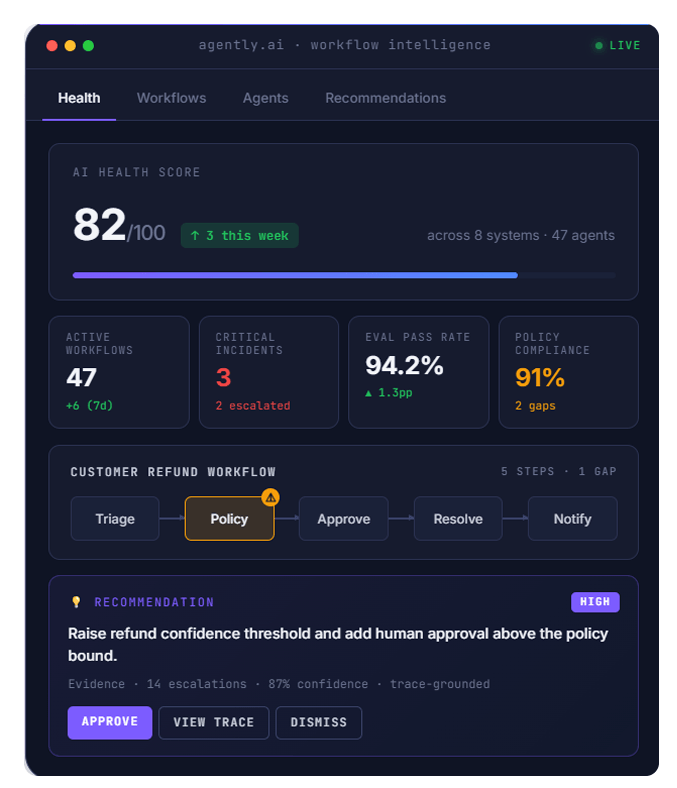
A concrete example of what Agently does, on a workflow every enterprise runs. Illustrative workflow based on common enterprise refund-control patterns.

  1. Spike detected
    Escalation rate on the Customer Refund workflow rises 38% week-over-week. Agently surfaces the anomaly before the next leadership review.
    SIGNAL Β· alert.workflow.escalation_spike
  2. Root cause mapped
    Traces and evals join in one view. Triage agent confidence is below threshold on refunds over the policy bound. Policy gap visible at the workflow level.
    TRACE Β· 412 sessions Β· 87% confidence avg
  3. Recommendation generated
    Trace-grounded fix: raise confidence threshold above the policy bound and route to human approval. Evidence attached. Reusable playbook.
    REC Β· refund_threshold_v2 Β· HIGH priority
  4. Approved by owner
    Routed to the process owner with the evidence, the trace, and the predicted impact. One-click approval. Audit retained.
    APPROVAL Β· process_owner@acme.com Β· t+18h
  5. Verified after deploy
    Escalation rate measured 7 days later. Down 64%. Verified. Playbook published to the library for the next team running a similar pattern.
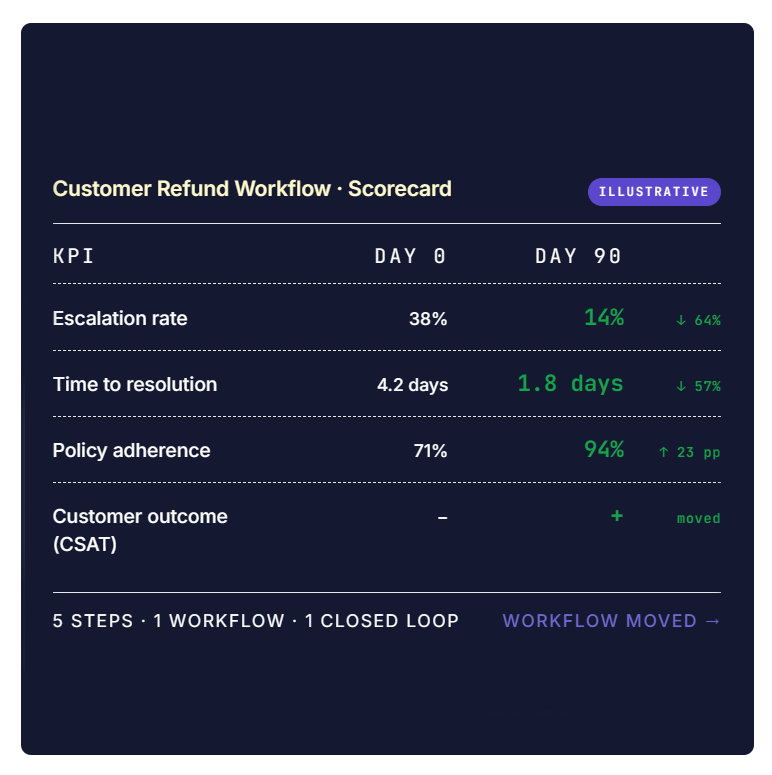
    VERIFY Β· -64% escalations Β· published
05 Β· Connects to the stack you already run

No rip-and-replace.

Read-only by default. Write back only with named approvals.

Agent platforms

The builders + runtimes your teams use to ship agents

Data platforms

Tables, ground-truth, and analytics layers agents read from

Cloud runtimes

Where agents execute, regardless of provider

ITSM + collaboration

Where incidents route and approvals get logged
06 Β· Headless Β· Slack + Teams

Ask Agently in Slack or Teams.

Teams can query Agently in supported collaboration channels and receive evidence-backed answers from connected catalogs, traces, policies, and recommendations.

Process owners, AI Ops, and platform leads ask Agently the questions they ask each other today β€” but Agently answers with the catalog, the trace, and the recommendation attached.

No new tool to learn.
No dashboard to onboard.
The catalog comes to where the conversation already happens.

Which agents are running in Salesforce? Slack
Which workflows do they touch? Teams
Which workflows have approval gaps? Slack
What changed in the Customer Refund Workflow this week? Teams
07 Β· Outcomes

From agent visibility to operational control.

Fewer hidden agent failures
Drift, regressions, policy gaps surface as evidence before they hit customers.
Better policy and approval coverage
Gaps detected at the workflow level. Approval routing tightens every cycle.
Faster root cause analysis
Traces, evals, and outcomes joined in one view. Minutes instead of war rooms.
Lower AI operating risk
Audit-ready evidence for procurement, compliance, and board updates.
Reusable remediation playbooks
Every fix becomes a published pattern the next team can apply.
Workflow-level business intelligence
Process owners see scorecards tied to the outcome the workflow is supposed to produce.
08 Β· Deployment + trust

Deploy where your data lives.

Two options. Same product. Audit retained in both.

Agently Self-Hosted
Customer-controlled deployment option for teams with stricter architecture, residency, or security requirements.Final architecture is confirmed during enterprise evaluation.

What you get in both

  • Read-only first, where supported by source systems
  • Write-back actions require configured permissions and named approvals
  • Configurable audit logging for key actions, approvals, and recommendations
  • Secrets handled through configured secret-management workflows β€” not intended for display in the application UI
  • Self-hosted deployments can be configured so identifiable data remains in the customer-controlled environment
  • Security review materials are available during enterprise evaluation
09Β· Path to value

A phased path to first workflow intelligence.

Each phase brings one capability live. Timing depends on source access, scope, and deployment model. The phases below are indicative.

Day 30 Β· Phase 1
Agent
Catalog live.
Every AI agent across your stack inventoried β€” name, owner, environment, risk posture, platforms touched.
  • Source of truth for every running agent
  • Ownership + risk-tier map
  • Read-only β€” no production change
Day 60 Β· Phase 2
Workflow Catalog live on your first 3 workflows.
Agents mapped into the business workflows they run. Policies, handoffs, approval gaps, outcome tags.
  • Workflow-level scorecards for process owners
  • End-to-end mapping + approval-gap detection
  • Workflow-level governance starts here
Day 90 Β· Phase 3
Intelligence
Engine live.
Evals, traces, trace-grounded recommendations, self-improving loop. Every workflow run makes the next one better.
  • Detect β†’ recommend β†’ approve β†’ verify, on every workflow
  • Reusable playbook library
  • End-to-end in three months
10 Β· Questions, answered

What CIOs ask before they pilot.

What is Agently?
Agently is the Enterprise Workflow Intelligence platform. It gives leadership workflow-level visibility, governance, evaluation, tracing, and remediation for AI agents running across Salesforce Agentforce and the modern enterprise stack.
Does Agently replace Salesforce, ServiceNow, or other enterprise systems?
No. Agently sits on top of the systems already in production and connects the operational context across them so the enterprise can detect, explain, recommend, approve, and verify fixes β€” without changing the underlying systems.
How is Agently deployed?
Two options: Agently Cloud (hosted by Agently β€” the fastest path) or Agently Self-Hosted (customer-controlled deployment for teams with stricter architecture, residency, or security requirements). Read-only first where supported by source systems. Write-back actions require configured permissions and named approvals. Configurable audit logging in both modes.
How long does Agently take to deliver value?
The full platform live in 90 days, end-to-end. Day 30: Agent Catalog live. Day 60: Workflow Catalog live on your first three workflows. Day 90: Intelligence Engine live (evals, traces, recommendations, self-improving loop). You can stop after any phase and keep what you have built.
Is Agently a Teqfocus product?
Yes. Agently is built by Teqfocus β€” a Salesforce Summit Consulting Partner with enterprise delivery experience across Salesforce, Data, AI, and Cloud. For demos and commercial conversations, contact andy@teqfocus.com.

What happens in a workflow review.

In 45 minutes, we map one workflow with you. Here’s what we look at β€” together, on a call, with your real workflow.

  1. Agents involved.
    Which agents β€” across Salesforce Agentforce or your first approved source β€” touch this workflow today.
  2. Actions they take.
    The decisions, reads, writes, and approvals each agent contributes.
  3. Systems and handoffs touched.
    Where the workflow crosses platform boundaries and where things drop.
  4. Owners and approval gaps
    Who’s accountable for which step β€” and where the policy gaps live.
  5. First risk signals.
    The early indicators Agently would surface once the catalog and workflow map are in place.

Bring one real workflow. We’ll show what becomes visible.

A 45-minute working session on a workflow you actually run β€” refund, claim, onboarding, incident triage. You’ll see exactly what Agently surfaces on day 1, day 30, and day 90.