
 Teqfocus
What Claudeforce Actually Means for Your Salesforce Org — and the Part Nobody’s Talking About
By Teqfocus COE
23rd Oct, 2026
On August 26, 2026, Salesforce and Anthropic announced Claudeforce an official partnership that embeds Claude as the default reasoning engine across the Salesforce platform. By September 15, it became part of a broader AIforce announcement at Dreamforce, framed as a fundamental shift in how enterprise teams interact with their CRM.
This post is our take on what Claudeforce is, what it practically changes, and the gaps most orgs need to close before deployment delivers what the announcement promises.
What Claudeforce Is
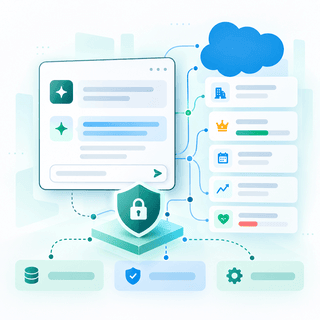
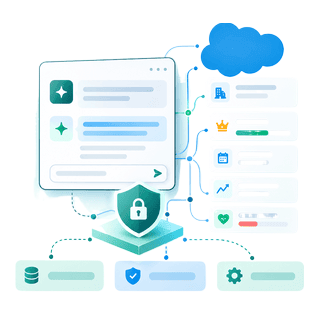
Claudeforce brings your Salesforce org into Claude’s interface. Rather than opening Salesforce to run a pipeline review, check deal health, or prep for a customer call, your team does it directly inside Claude. Salesforce ships it with 37 prebuilt sales skills covering meeting prep, deal review, pipeline analysis, and more. Permissions inherit from existing Salesforce roles, so access stays scoped to what each person already has in the system.
Claudeforce is one component of AIforce the broader platform architecture Salesforce announced at Dreamforce. The premise: rather than pulling people back into Lightning, Salesforce comes to wherever work is happening. Claudeforce is the Claude surface. Slackforce is the Slack surface. Agentforce Coworker sits as an embedded AI teammate inside Lightning itself.
Salesforce is committing $300 million in Anthropic tokens to this in 2026 alone, on top of an existing equity stake in Anthropic. That is not experimentation. That is a platform commitment.
What Changes for Your Team
The most immediate shift is in sales workflows. Instead of switching between a research tab, a CRM, and a prep document before a customer call, a rep describes what they need and Claude surfaces the relevant Salesforce data, prior interactions, and open tasks in one pass. The interface is conversational rather than navigational a meaningful difference in a high-volume sales environment.
For RevOps and sales leadership, the analytical workflow compresses. Pipeline reviews that previously required building a Salesforce report, exporting it, and forming a narrative become a single structured query. Across a team, that compounds quickly.
Admins face a near-term validation task. Permissions inherit from Salesforce roles, but confirming that inheritance behaves correctly across every profile before rollout takes deliberate testing. The effort is not large, but it is not something to skip.
What Claudeforce Does Not Do — This Is the Part Worth Reading
Claudeforce surfaces your Salesforce data. It does not improve it.
If opportunity records are missing close dates, account fields are inconsistently populated, or contact relationships are stale, Claudeforce makes that visible faster and with more confidence. A rep asking about a deal’s status gets an answer based on what is actually in the record. If the record was last updated three weeks ago by someone who has since left, the answer is three weeks stale delivered fluently.
This is not a defect in Claudeforce. It is the structural constraint of any AI layer that sits on CRM data: output quality is bounded by input quality. Frontier reasoning on poor data produces confident answers that are wrong.
The second gap is governance. Claudeforce inherits Salesforce permissions, but agentic workflows introduce a different category of question. When an AI agent acts on behalf of a rep updating an opportunity, logging an activity, drafting a follow-up what it is permitted to do, what it logs, and how those actions are audited require explicit design. A permission model defines what a role can see. It does not define what an agent is authorized to do on that role’s behalf.
The Data Foundation Your Org Needs
As both a Salesforce Summit Partner and Anthropic Select Partner under the Services Delivery track, Teqfocus works at the intersection of these two platforms. The readiness question we consistently hear from CIOs and CDOs comes down to the same two things: clean, governed data in Salesforce, and a defined harness around agent actions.
The fields Claudeforce’s skills rely on most are predictable: opportunity stage, close date, last activity, contact roles, and account health signals. If those are in good shape, the out-of-the-box experience performs. If they are not, the remediation path is well-understood. This is data transformation work most orgs have started but not finished. Completing it with AI workflows as the target not just reporting reframes the same underlying effort.
The Governance Layer Agents Require
Agentic AI in enterprise settings needs a harness: the defined controls over what an agent can access, what actions it can take, and how every decision it makes is logged and audited. Without it, capable AI operates without accountability creating exposure to errors, compliance gaps, and board-level questions with no clean answers.
As Claudeforce moves from read-only workflows toward write actions, the governance scope grows with it. Building that control layer before deployment is the work our AI Harness Engineering practice handles not as an afterthought, but as the deployment foundation itself.
The Deployment Sequence That Works
Claudeforce is in beta now. Orgs that use this window to assess their data state and define their governance model will deploy into an environment that is ready. Orgs that deploy first and patch later will spend Q1 2027 explaining to their boards why AI-assisted pipeline reviews keep producing stale, confidently-stated information.
The sequence is: assess what is clean and what is not, close the data gaps AI workflows depend on, define the governance model for agentic actions, then deploy. For most orgs it takes weeks, not quarters.
Work Through This With Us
If your team is working through the Claudeforce readiness question and wants a structured conversation with practitioners who work across both Salesforce and Anthropic, contact us to set up a focused architecture call. We can typically surface the three to five decisions that need to happen before deployment in a single session.
Claudeforce is a meaningful advancement. The orgs that benefit most from it will not be the ones that moved first. They will be the ones that moved deliberately.