Agentic Workflows Are in Production.
Now the Real Work Begins.
What Q4 delivery conversations are actually about right now: governance timing, architecture sequencing, and why the two are the same problem.
Two Patterns Keep Showing Up in Q4 Delivery.
Together, They Explain Most Governance Timing Problems.
Two patterns keep showing up in Q4 delivery conversations. They are related, and together they explain most of the governance timing problems I am seeing.
These observations come from actual conversations with technical teams this quarter anonymized, but not synthesized. I am sharing them because I keep hearing versions of the same thing, and if you are working on an agentic build right now, you will probably recognize at least one of them.
The most common architecture mistake I see in first agentic builds is starting with data context rather than a specific use case. The logic is not wrong: agents need data, so you start by connecting the sources, building the embeddings, mapping the schemas. You are building the foundation. The problem is that this path spends six to twelve months building infrastructure before the business sees any output from an agent in production.
One enterprise team I spoke with this quarter described it plainly. They had spent the better part of a year building a comprehensive context layer well-designed, technically sound before they had a single agent running in production. What finally changed their approach was reframing the question: not "what context does an agent need" but "what is the one thing we want an agent to do next week, and what is the minimum context required for that specific action?" Same destination, completely different delivery timeline.
The teams I see moving fastest on agentic builds are starting from one specific use case and working backward to exactly the context that use case requires. They are not building a general-purpose agent platform. They are building one agent that does one thing well, then expanding. The context layer grows with the use case portfolio instead of preceding it.
"Starting with use case rather than context is not a shortcut. It is a different sequencing that produces the same result without the year of invisible progress before the first agent goes live."
A separate team I spoke with this month described a prior pilot that was technically solid the agent worked, the outputs were good, the error rate was acceptable. Adoption was near zero. They dug into it and found a simple structural problem: users had to leave the tool they worked in every day to interact with the agent. Even a small behavior change open a new tab, navigate to a separate interface, copy results back was enough friction to make the pilot invisible in practice.
Their current build embeds the agent inside the tool the team already uses. No separate interface. No behavior change required. The agent surfaces inside the existing workflow context, at the moment it is relevant. That one structural decision changed the adoption conversation completely. The pilot that followed had uptake in the first week that the previous one never reached in its full run.
I have heard a version of this from multiple teams this quarter. The agent was fine. The adoption model was not designed. These are different problems, and only one of them gets fixed by improving the agent.
Why Governance Keeps Arriving Late.
It Needs a Concrete Use Case to Have Any Content.
Here is the connection I keep coming back to. When teams build context-first, governance gets deferred alongside everything else because there is no specific action, data boundary, or user behavior to define controls around yet. The governance conversation requires a concrete use case to have any content. When you are building a general context layer, the question "what access policy applies here" has no answer yet.
By the time the agent goes live, the governance layer is already six to eight weeks behind the deployment. Not because anyone forgot it because there was nothing concrete to build governance around until the use case was defined, and the use case got defined at the end of the architecture process instead of the beginning.
"Governance and use-case definition are the same conversation. That conversation should happen before the architecture, not six weeks after the first agent goes live."
Starting from a specific use case fixes both problems at once:
Kill Switches, Spend Visibility, Shared Definitions.
Governance Is Now a Configuration Task.
Three platform moves from the last four weeks, and what each one means for your team.
What shipped October 27 is the production cost and control layer for Agentforce the tooling that answers the question "how do we stop an agent from doing something we didn't intend." The evaluation layer that answers "how do we know the agent is doing what it should" follows in January.
As of November 16, the unified admin surface became the default configuration for new Claude Enterprise accounts. If you are managing an existing rollout, your deployment migrates on request.
For enterprise IT teams, this removes a blind spot that has been a recurring friction point: Claude usage spreading across a team with no visibility into what it was costing or which models were being called. That visibility now exists without an engineering request to build a custom logging layer.
Snowflake also announced Cortex Training in public preview, enabling teams to post-train open-weight models on their own Snowflake data using managed GPUs Qwen, DeepSeek, Mistral, Gemma. Same pattern across all three: governance and context, closer to where the data lives.
Context Is the Competitive Advantage.
Not the Model.
Two conversations ran the same evening. Both landed in the same place.
"You can rent intelligence. You cannot rent accountability."
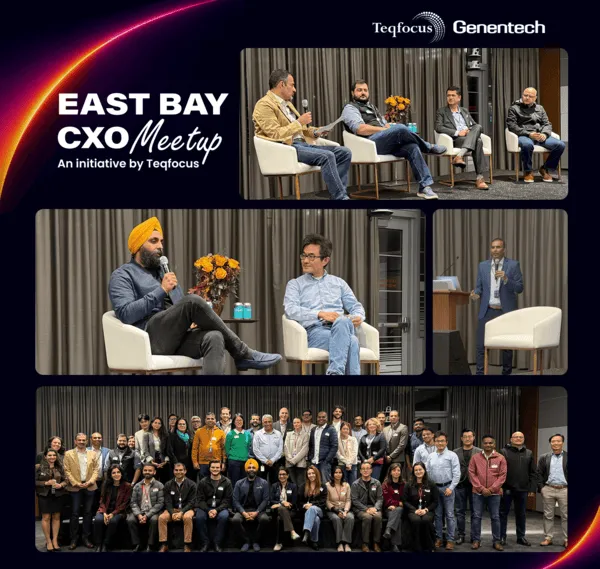
The November session of the East Bay CXO Community wrapped Tuesday evening at Genentech Building 35. Technology and data leaders from Genentech, Stellarus, and iRhythm joined Andy Singh and Jas Kaur from Teqfocus for a panel conversation on why AI delivers in some enterprise environments and stalls in others. The room covered a lot of ground, but one line from Andy's fireside with Dr. Ganhui Lan (VP Data Science, Genentech) stayed with the conversation after: "You can rent intelligence. You cannot rent accountability."
The panel touched on something the audience kept returning to: "If AI saves someone 20 minutes a day, is that ROI, or have we become too generous about what we call AI value?" The discussion landed on the same place the data almost always does. Accuracy is what the model does. Outcome is what the person does next. The teams seeing real returns are not building better models. They are building better context around models: their data, workflows, rules, and institutional knowledge, and knowing where they are willing to let AI act. The December session date and location will be announced shortly.
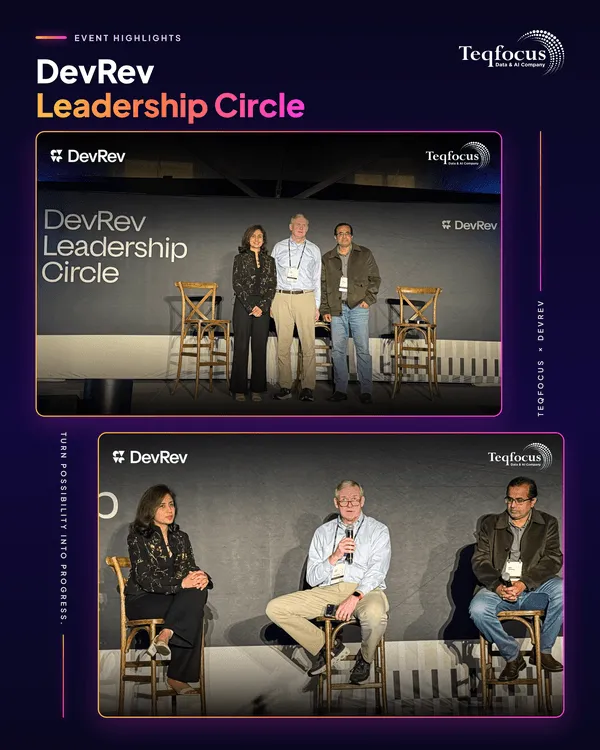
The DevRev fireside ran the same evening as the CXO forum, covering the question most enterprise AI leaders face once the first deployment is live: how do you decide what to build next, and what do you need in place before you can? The conversation moved through problem selection, reach, prerequisites for the next capability layer, and what AI governance looks like when you are no longer just piloting.
The opening question set the frame for everything that followed: when AI first landed on your agenda, how did you decide which problems were worth solving with it, and which one did you start with? The answer to that question almost always determines whether the second deployment is six months away or eighteen. If you are past your first deployment and figuring out the sequencing for Q1, the frameworks from this session are relevant.
The November episode of TeqTalk goes into one of the more unusual infrastructure questions now sitting on the AI roadmap: what happens to the physical constraints on AI compute if the data center is not on the ground. The episode covers the technical and commercial viability of space-based compute, what it would take for it to become a real infrastructure option, and what it means for the energy and latency assumptions enterprise AI currently runs on.
Worth the time if you have anyone on your team thinking about AI infrastructure at a planning horizon past 18 months. The near-term deployment questions are well-covered. The infrastructure questions behind them are not.
Get the Sequencing Right in Q4.
Have a Cleaner Q1.
The governance timing conversation is the most important one happening in enterprise AI right now, and it is not getting enough attention relative to the architecture and capability conversations. Teams that get the sequencing right in Q4 will have a significantly cleaner Q1. Teams that defer it will spend the first quarter of the year on remediation work that was preventable.
If any of this connects to what your team is working on whether it is governance configuration, architecture sequencing, or just trying to figure out where to start in Q1 reply here. That is what this newsletter is for.
The November CXO forum wrapped Tuesday with a room full of people who had genuinely hard questions about where their AI programs go from here. That is exactly the conversation this newsletter is trying to extend. The December session date and details are coming. If you want to be on the list when they do, reply here.
GTM Director, Teqfocus